
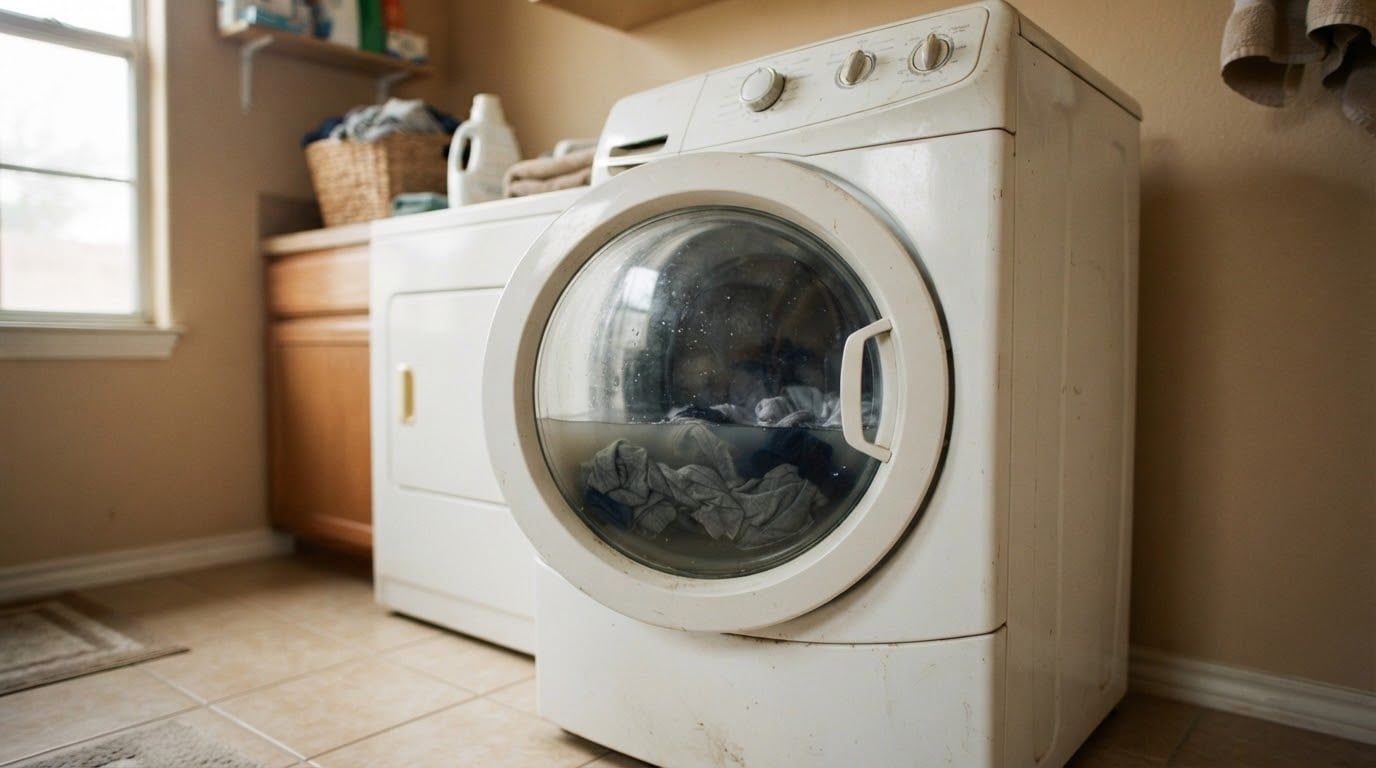
Washer stopped mid-cycle with water in the drum
Every load leans on the same short run of parts: a drain pump, a door lock or lid switch, a water inlet valve, a motor and the bearings that carry the drum. On LG, Samsung, Whirlpool, Maytag and GE washers, the fault is usually in one of those, or in the hoses and the drain behind the machine.
When it stopped tells the tech where to start. A washer that quits at the start of a cycle with a door code points to the lock. One that quits full of water points to the drain side. One that finishes but leaves the clothes soaking points to the spin. Give us that, plus any code on the display, when you call.
Leaking washer repair
Do these first to keep the water contained until the tech gets there.
- Pull the washer's plug or flip its breaker off before you reach anywhere near the water.
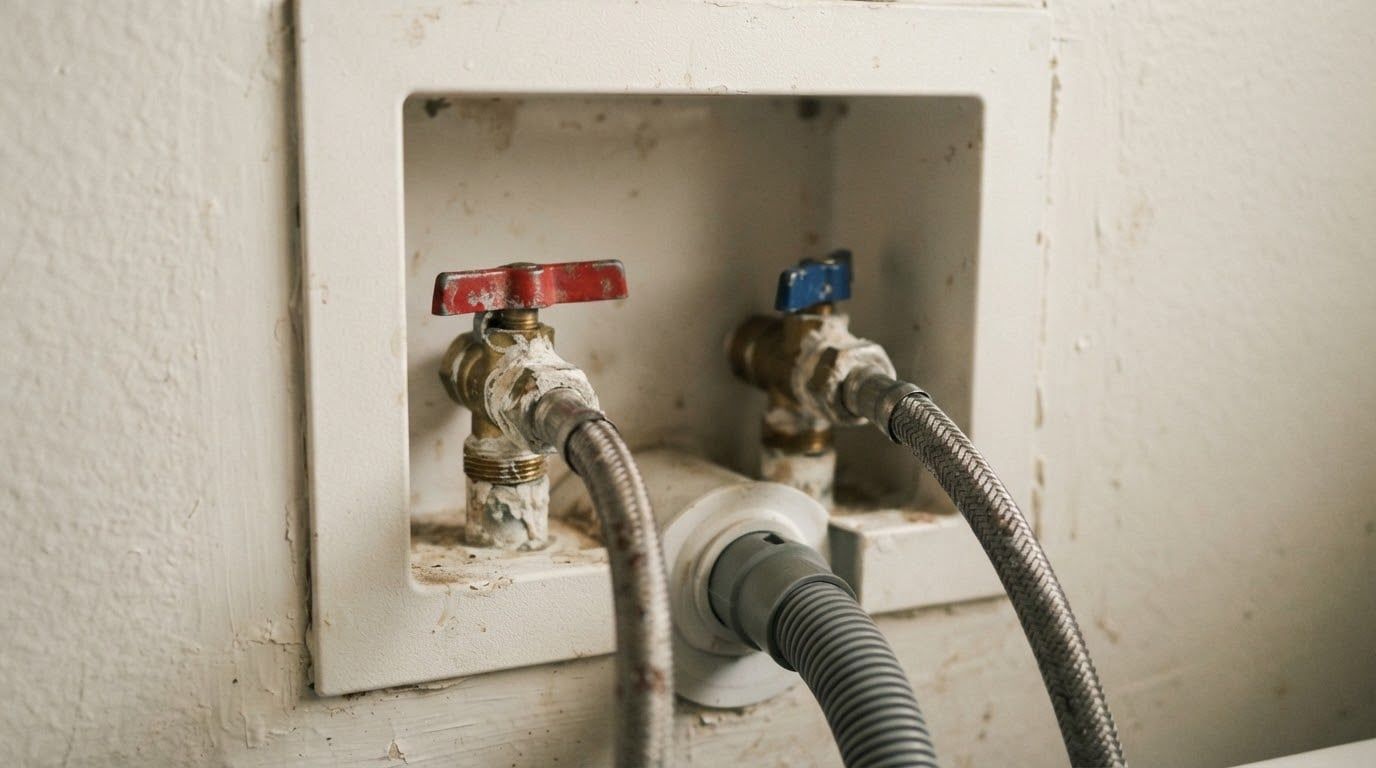
- Close both faucets behind the washer.
- Lay towels along the front. On a front-loader, keep the door shut while water sits above the bottom of the door glass.
- Then call us and say whether the water showed up while the washer was filling, draining or spinning, and whether the laundry room is upstairs.
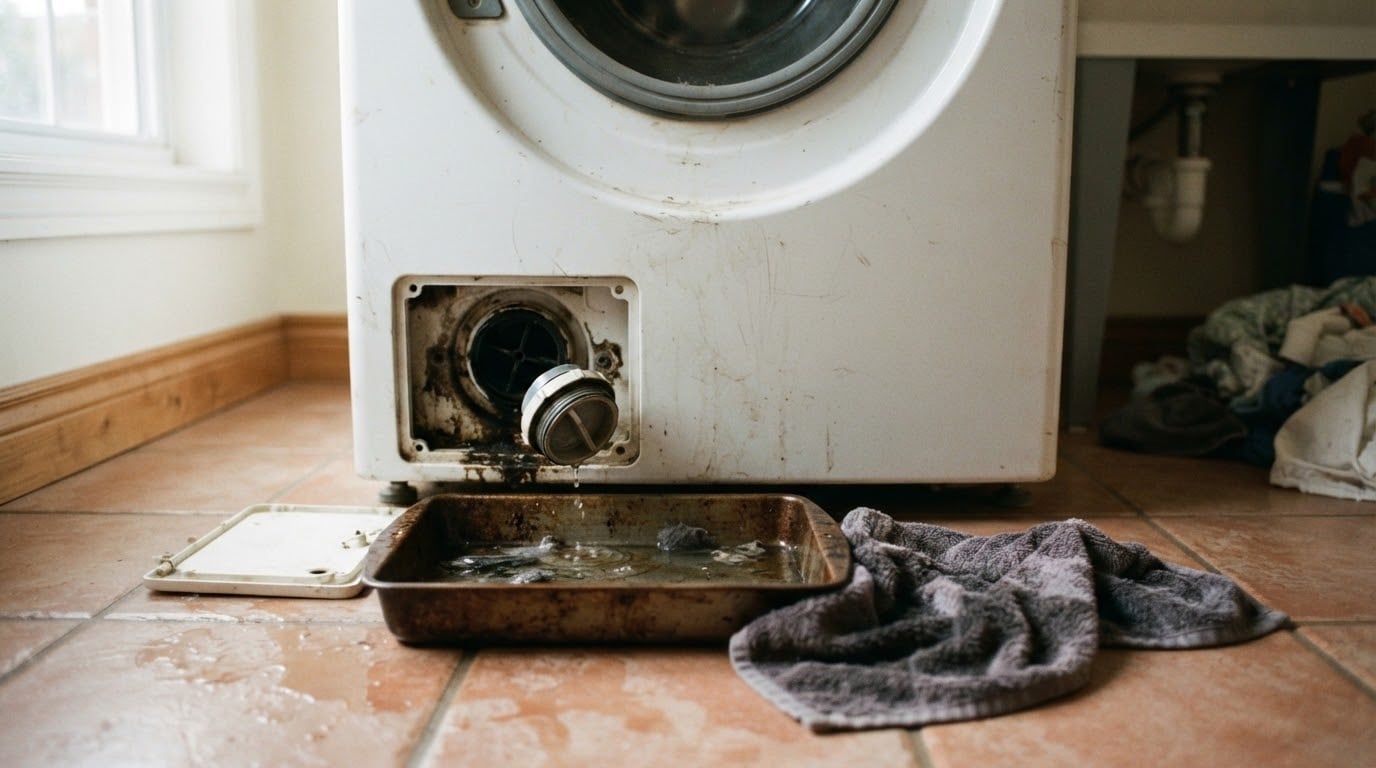
Washer not draining or not spinning: the usual parts
Washer leaves water in the drum after the cycle
Washer drains fine, but the clothes come out soaking
Washer won't start, or stops with a door or lid code
Washer fills slowly, or shows a fill error right at the start
Washer roars like a jet engine on the spin cycle
Banging, or the washer walking across the floor
Drain and fill codes on LG, Samsung and Whirlpool washers
Read the code to us exactly as it shows. A lot of drain and fill codes trace back to a hose or a screen rather than a failed part. The rest of the laundry codes are in the appliance error code library.
| Code | What it means | What the tech checks |
|---|---|---|
OE | LG: the washer can't drain | Kinks in the drain hose, a full pump filter, oversudsing, then the pump |
5C / 5E / nd | Samsung: no drain | The drain hose and the debris filter on models that have one, then the pump |
F9 E1 | Whirlpool front-load: long drain time | How far the hose sits down the standpipe (no more than 4.5 in.), the pump filter, the pump |
4C / 4E / nF | Samsung: not filling | Faucets fully open, the inlet screens, then the inlet valve |
LF / F8 E1 | Whirlpool: not detecting the right amount of incoming water | Both hot and cold supplied and open, the hose screens, the valve |
dE2 | LG: door closed but not locked | Clothing caught in the door or gasket, the latch, the lock assembly |
PE | Samsung top-load: clutch position error | The clutch and its sensor, once a reset has failed to clear it |
Washer slow fill and hard water repair
The City of Houston's 2025 water quality report put the main system's average total hardness at 135.5 mg/L, about 7.9 grains per gallon, with a high of 229 mg/L. Every fill pushes that water through two small mesh screens at the back of the washer where the hoses thread onto the inlet valve, and the grit collects there. A slow fill is often a clogged screen, which is why the tech checks the screens before quoting a new valve.
Ask the tech to look at the fill hoses while the washer is pulled out. Whirlpool's replacement interval for fill hoses is five years, and a rubber hose that bulges or cracks near the crimp can split and flood the room.
Front-load vs top-load washer repairs
Front-load repairs usually cost more than top-load ones, going by national averages. Most of the difference is in the parts behind the drum.
Front-load washers
- The rubber door boot only exists on front-loaders, and replacing a torn one runs $275 to $600 nationally.
- The spider arm bolts to the back of the drum. Replacing it runs $350 to $900, usually alongside new bearings.
- On many models a small door at the bottom front hides the pump filter, where socks and coins end up.
- On most models the door has to lock before water comes in, so a lock fault stops the washer at the very start.
Top-load washers
- A worn belt ($100 to $200) or transmission ($200 to $600) shows up as a tub that fills but never agitates or spins.
- Worn suspension rods make top-loaders bang, and shock absorber work runs $100 to $350.
- The drain pump sits under the cabinet, so clearing a jam means getting underneath.
- Samsung top-loaders can show PE, a clutch position error that Samsung says needs service if a reset doesn't clear it.
Washer repair costs by part
National averages, installed unless noted, with the typical washer repair near $200. After the diagnosis the tech writes down the price for your machine, and the work waits for your go-ahead.
| Repair | Typical range | Notes |
|---|---|---|
| Service call and diagnosis | $70 to $130 | Usually travel, diagnosis and the first hour |
| Drain pump | $150 to $350 | Pump alone $20 to $100 |
| Water inlet valve, door lock or lid switch | $100 to $300 | Valve alone $20 to $100, latch $20 to $130 |
| Drive belt | $100 to $200 | |
| Shock absorbers | $100 to $350 | |
| Tub bearings | $100 to $250 | With a new outer tub, $600 to $800 or more |
| Transmission | $200 to $600 | Mostly top-load agitator models |
| Front-load door gasket | $275 to $600 | |
| Spider arm | $350 to $900 | Front-load |
| Control board | $350 to $550 | Board alone $100 to $300 |
A new washer averages $700 to $1,300 nationally. For dryer, dishwasher and kitchen prices, see the appliance repair price guide.
Ten-year-old washer: fix it or let it go?
Ten years is about the expected life. NAHB's life-expectancy figures give a washer roughly 10 years, a few less than a dryer. National cost guides draw the line earlier: fix a washer under 7 years old, one still under warranty, or one where the repair comes to under half the price of a new machine.
The part decides it more than the age does: a $150 drain pump or a $120 inlet valve on a 10-year-old top-loader buys more years for a fraction of the $700 floor on a new washer, and neither job touches the parts that wear out with age. Bearings are where the answer flips. Once a front-loader needs a spider arm on top of bearings, the repair can climb past $1,000 to rebuild the part that ages fastest, while the seals, pump and board keep getting older.
Check the warranty on the motor and drum before deciding, and mention it when you call. LG covers its washer drum motor for 10 years, and on many models the stainless drum for life, both parts only. Samsung offers 10-year coverage on the Digital Inverter Motor on many models, with terms tied to the model and purchase date. On Maytag washers made after 2017, the 10-year limited parts warranty takes in the drive motor and the stainless wash basket. The Maytag washer repair page has the details.
Efficiency tips the math a little toward replacing a very old machine. ENERGY STAR says certified washers use about 20% less energy and 30% less water than standard ones, 14 gallons a load against 20, and estimates about $530 saved in energy costs over a washer's life. The repair or replace guide runs the same test for every other appliance.
Where the washer model label hides
Tell us the brand and whether it's a front-load or top-load. On most washers the model label is under the lid, around the door opening or on the back panel. Whirlpool Corporation also owns Maytag, KitchenAid and Amana. Brand warranty notes are on the LG washer repair and Samsung washer repair pages, and if the dryer beside it now needs two cycles, the dryer repair page covers heat and vent faults. We take washer calls from Houston and from parts of Bellaire, Stafford, Missouri City and Sugar Land. Covered ZIPs are listed on the service area list. Don't see your ZIP? Call anyway and we'll check your address.
Washing machine repair questions
How much does it cost to fix a washer that won't drain?
It depends where the blockage is. If the drain pump has failed, the national range is $150 to $350 installed, with the pump itself $20 to $100. A clogged pump filter or a kinked hose usually comes down to the service call, about $70 to $130 nationally.
Why does my washer smell even though it looks clean?
The smell usually lives where you can't see it: in the folds of a front-load door gasket, in a pump filter holding old water, or in detergent residue on the outer tub. Too much detergent feeds it. The tech checks the gasket and the filter, and LG's own advice is a Tub Clean cycle once a month.
Can I keep using a washer that bangs during the spin?
Not if it bangs on every load or the drum rocks when you push it by hand. An occasional thump from a lopsided load is normal. A roar that grows louder over weeks usually means bearings, and running it that way can damage the tub or crack a front-load spider arm.
Why does my washer drain but not spin?
Before it spins, the washer has to confirm the lid or door is locked and the load is balanced, so the lock, the lid switch and a tangled load come first. On top-loaders, a worn belt or drive coupler can let the motor run while the basket sits still.
Does LG's 10-year motor warranty cover the whole repair?
It covers the part, not the labor. LG's US warranty covers the washer's drum motor (stator, rotor and hall sensor) for 10 years on parts only, for the original buyer. Mention it when you call and keep the receipt with the model number handy.