
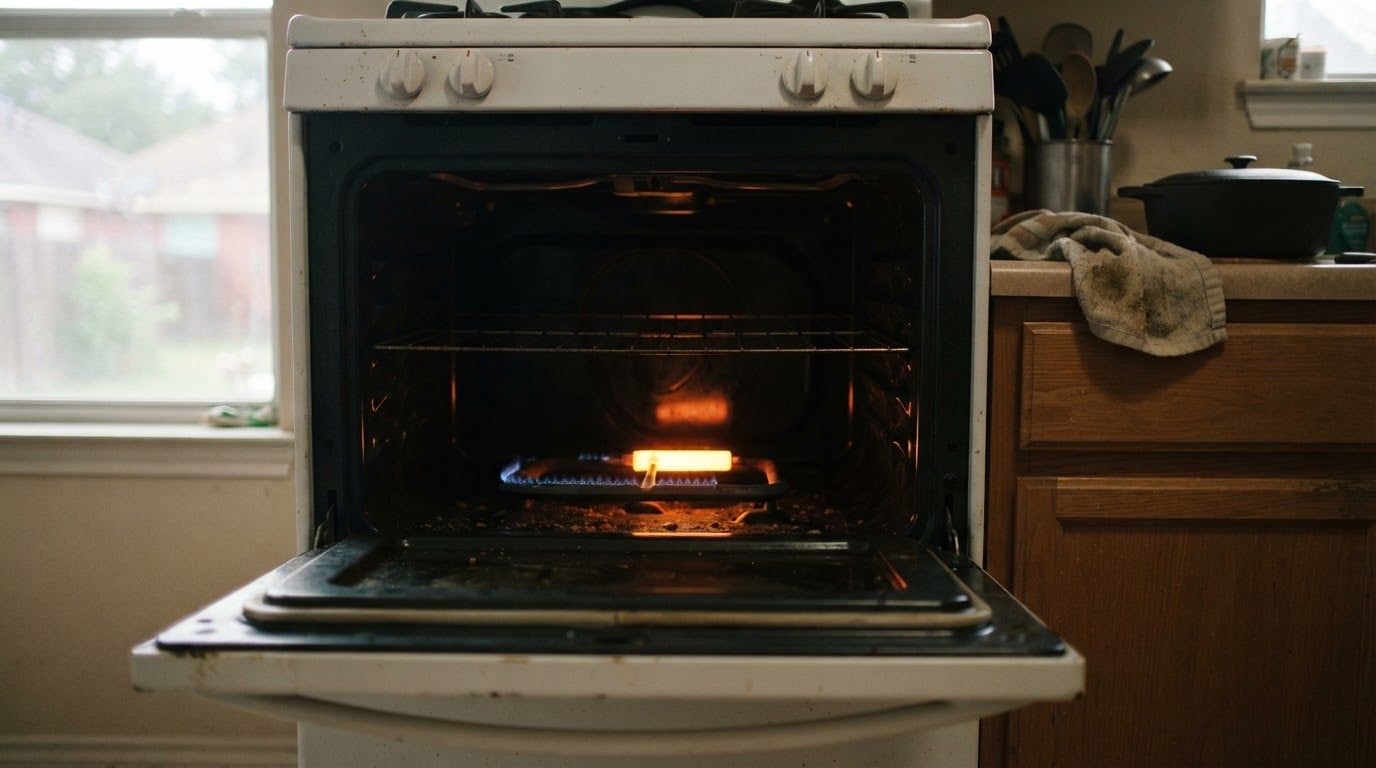
Oven won't heat, or cooks wrong
Tell us first whether the range runs on gas or electric. The same complaint points to an igniter or a gas safety valve on one and a bake element, relay or control board on the other. The codes below come from GE and Frigidaire support pages; Whirlpool, KitchenAid, Samsung and LG ranges are built from the same kinds of parts.
Gas oven igniter glows orange but the burner never lights
Cooktop burners work, oven stays cold
Oven burns food outside and leaves it raw in the middle
Oven broils but won't bake, or the reverse
Oven door stays locked after self-clean
Oven display blank, nothing responds
Gas oven repair after a power outage
A gas oven still runs on electricity. GE Appliances says the glo-bar igniter and the gas valve both need power to open, so an oven that was baking when the lights went out shuts off with no gas flowing. An electric range gets nothing during an outage, cooktop or oven, and either type comes back with the clock and any bake program wiped.
So if the oven worked before a summer storm and won't light afterward, say that on the call. The tech checks the outlet behind the range and the breaker before blaming the igniter. A display that stays blank, or a control throwing codes it never showed before, can mean a surge damaged the board.
Oven igniter and element replacement costs
National averages put a typical oven repair at $150 to $350 and a stove repair at $100 to $300, about $250 on average across both. Gas appliances usually cost 10% to 20% more to repair than electric ones. Your tech pins down the Houston price once the faulty part is found, and you get it in writing to approve.
| Repair | Typical range | Notes |
|---|---|---|
| Trip and diagnosis | $70 to $130 | Usually takes in the first hour on site |
| Gas oven igniter | $150 to $325 | Part $20 to $50; most of the cost is labor under the oven floor |
| Gas cooktop burner igniter | $100 to $200 | |
| Bake or broil element | $150 to $450 | Part $15 to $100 |
| Temperature sensor | $100 to $250 | |
| Thermostat | $100 to $350 | Older ovens with a mechanical thermostat |
| Gas safety valve | $150 to $400 | |
| Control board | $150 to $600 | Part $60 to $250 |
| Door glass | $125 to $500 | |
| Gas oven repair, overall | $100 to $600 | Electric oven repairs run $100 to $200 |
| Gas stove repair, overall | $150 to $400 | Replacing a stove igniter typically runs about $200 |
These are national ranges with parts and labor in, unless a part price is given. Fridges, washers and the rest are compared in the Houston appliance repair cost guide.
Gas range or electric: where each one wears out
Gas and electric ranges wear out in different places, so the tech starts the diagnosis in a different spot on each.
Gas ranges and ovens
- The oven glo-bar igniter under the floor panel, the usual reason a gas oven heats slowly or not at all
- Cooktop spark igniters and the spark module, which boil-overs tend to soak
- The gas safety valve, less common and pricier
- Household power for the igniter, valve and controls, so outages and surges count
Electric ranges and ovens
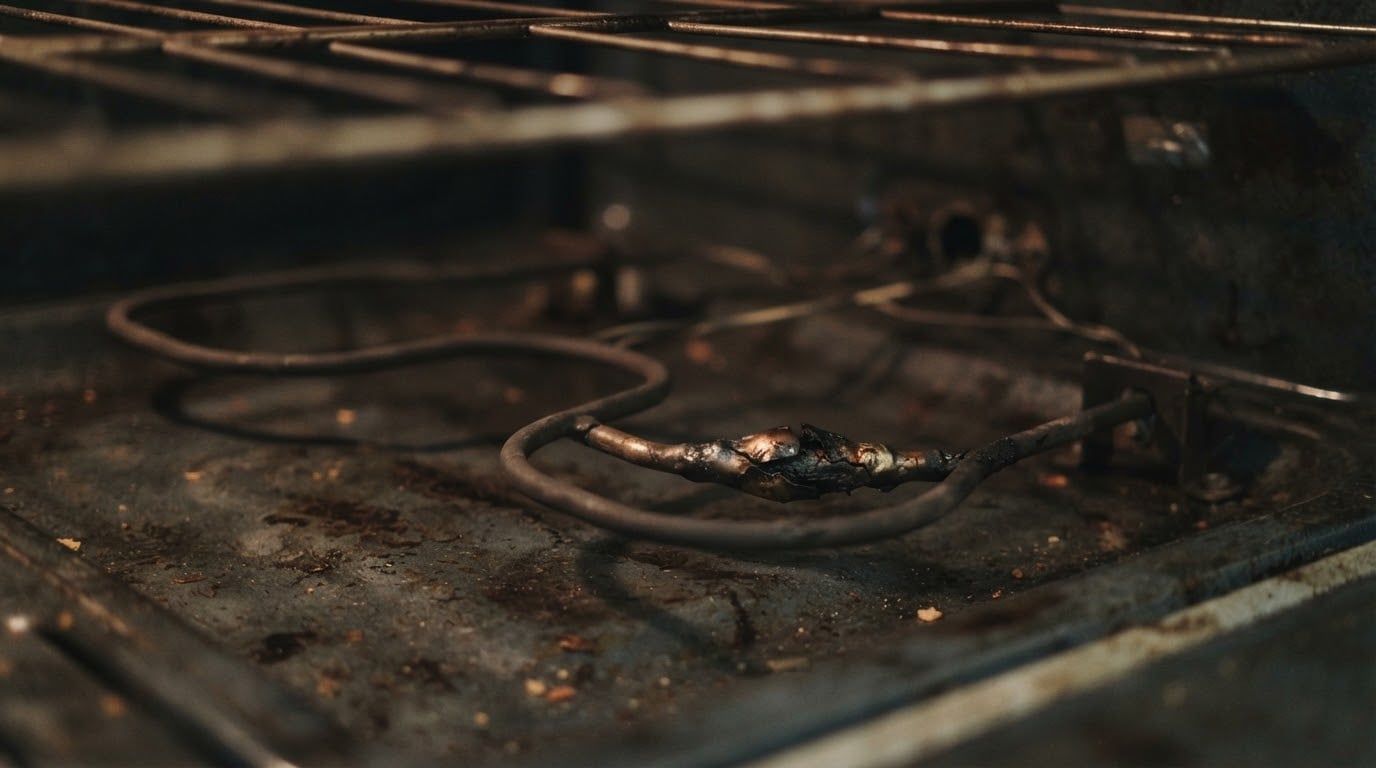
- Bake and broil elements, which often fail with a visible blister or split
- Coil elements and receptacles, or radiant elements under a glass top
- Infinite switches and relays that run each burner
- The temperature sensor and control board, shared with gas models
Range model numbers and error codes
Any of this helps the tech bring the right part. If you can't find something, call anyway.
- Gas or electric, and the style: standard range, slide-in, wall oven or double oven
- Brand and model number, often on a label around the oven door frame or behind the storage drawer
- Any code, written exactly as the display shows it
- Whether the cooktop burners still light, and whether the trouble began after a power outage
- The range's age, and whether it might still be in its first-year warranty
When a range repair beats replacing it
Usually. Gas ranges have the longest life expectancy of any major appliance in the National Association of Home Builders study, about 15 years, with electric ranges at 13 (industry estimates published in 2007). National cost guides suggest looking at a new oven once yours passes 10 to 20 years, and Consumer Reports' line is not to spend more than half the price of a new one on a repair.
Run two examples through that. A new igniter on a 12-year-old gas range is an easy yes, because the burners, valve and body may have years left. A control board quoted near $600 on a 13-year-old electric range, with a cracked glass top waiting behind it, is worth weighing against a new range first. The repair or replace guide works through the numbers for every appliance.
Brand notes are on the GE appliance repair, Frigidaire appliance repair and Whirlpool appliance repair pages, and more fault codes are in the error code library. Range calls come from Houston, Bellaire, Missouri City, Stafford and Sugar Land; the service area list shows each ZIP. Don't see your ZIP? Call anyway and we'll check your address.
Oven and stove repair questions
Why does my gas oven take so long to preheat?
A weakening igniter is the common cause. It still glows, but it takes longer to draw enough current to open the gas valve, so the burner lights late. A new igniter is the usual fix, and the part itself is $20 to $50, so most of the cost is labor.
Why do my stove burners click but won't light?
Moisture or food around the igniter after a boil-over is the usual reason, followed by a burner cap sitting off-center or clogged burner ports. Clicking that carries on once the cooktop is dry points to a spark switch or the spark module. The cooktop repair page covers burner faults in detail.
Should I keep using an oven that shows a high-temperature code?
No. GE's F2 or F20 and Frigidaire's F10 both mean the oven sensed heat above its normal limit. Switch the oven off and leave it off, then read us the code when you call so the tech knows to start with the sensor and the control.
Can an oven be fixed on the first visit?
Often, when it's an igniter or an element, since those are small, common parts. Safety valves and control boards tend to be ordered against your range's model number, which can mean a second visit. We'll set the first visit time when you call.
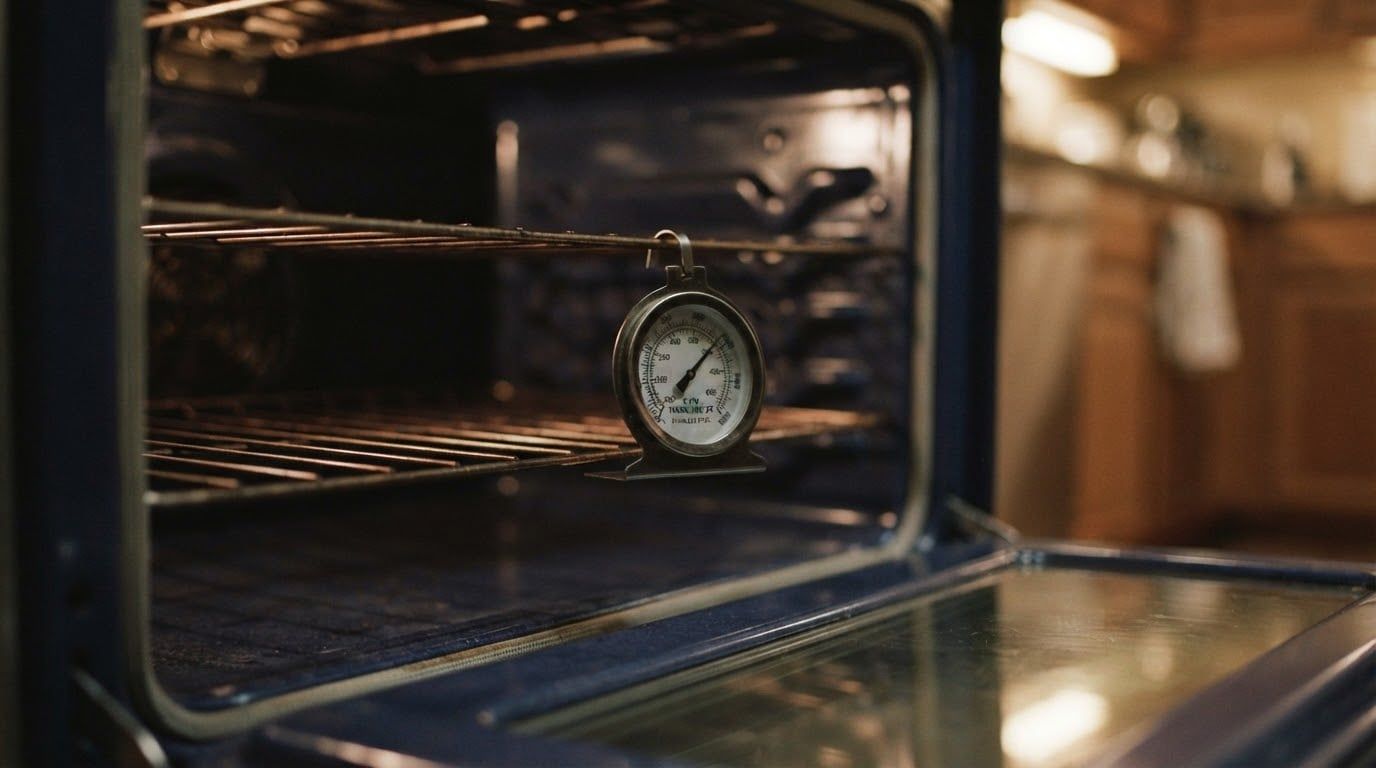
My oven runs hot or cold. Does it need a part?
Not always. Many Whirlpool controls allow a calibration adjustment of up to 30°F either way. An oven that's off by far more than that points to the sensor, a sagging element or the control, and the tech tests each one.